The Big Ass Calendar by Jesse Itzler: A Complete Guide to Designing a Year You’ll Actually Remember

Why Most People Feel Busy - but Accomplish So Little
Most people don’t have a productivity problem.
They have a time awareness problem.
Weeks fill up. Calendars overflow. Days are packed with meetings, errands, notifications, and obligations. And yet, when the year ends, many people struggle to point to anything that truly moved their life forward.
No defining moments.
No meaningful progress.
No memories that stand out.
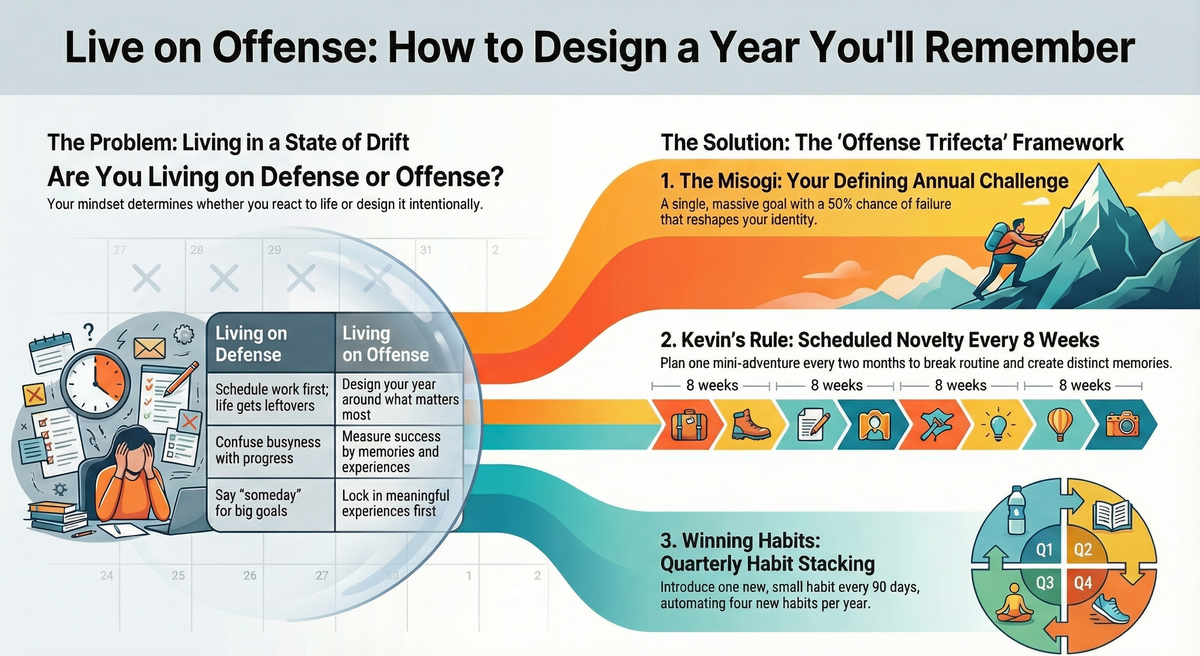
Jesse Itzler calls this state living on defense - a reactive way of living where time is dictated by external demands instead of intentional choices.
The result is what he describes as the drift:
A slow, invisible slide through the year where routines turn into ruts and life quietly passes without resistance.
The Big Ass Calendar exists to interrupt that drift.
What Is the Big Ass Calendar?
The Big Ass Calendar is exactly what it sounds like:
- A massive, four-foot-wide, dry-erase calendar
- A full 365-day, year-at-a-glance view
- Designed to live on your wall - not hidden in an app
But functionally, it’s something much deeper.
The Big Ass Calendar is a behavioral architecture tool. It’s designed to change how you see time - and therefore how you use it.
Instead of planning life one week at a time, it forces you to confront the reality of your finite annual time budget.
When you can see all 365 days at once, you can no longer pretend you have plenty of time later.
Why Jesse Itzler Rejects Digital Calendars for Life Design
Digital calendars are excellent for logistics - but terrible for life planning.
Here’s why they fail at a deeper level:
- They fragment time into months and weeks
- They hide the bigger picture
- They’re easy to dismiss and ignore
- They live behind screens, tabs, and notifications
The Big Ass Calendar does the opposite.
It creates visual salience - a psychological principle that says we’re far more likely to act on what we consistently see.
Every day, the calendar is there:
- Staring at you
- Judging your priorities
- Asking whether you’re actually building the life you want
You don’t check the Big Ass Calendar.
You live with it.
Living Life on Offense vs. Living on Defense
The Big Ass Calendar is built around one core idea:
Life should be designed proactively, not reacted to.
Living on defense looks like:
- Scheduling work first
- Letting family, health, and fun fight for leftovers
- Saying someday instead of choosing dates
- Confusing busyness with progress
Living life on offense looks like:
- Designing your year around what matters most
- Locking in meaningful experiences first
- Treating time as your most valuable asset
- Measuring success by alive time, not output
This philosophy flips traditional planning on its head. Instead of fitting life around work, you fit work around a fully lived life.
The Offense Trifecta: The System Behind the Calendar
The Big Ass Calendar works because it’s not just a blank canvas. It’s paired with a framework Jesse Itzler calls the Offense Trifecta - three intentional layers that ensure your year has depth, growth, and momentum.
The three elements are:
- Misogi – one massive, defining challenge
- Kevin’s Rule – scheduled novelty every eight weeks
- Winning Habits – small daily actions stacked quarterly
Each element serves a different psychological purpose, and together they create a year that feels full instead of fast.
Misogi: The One Challenge That Rewrites Your Identity
A Misogi is not a goal.
It’s a line in the sand.
The concept comes from an ancient Japanese Shinto purification ritual involving extreme cold exposure. Jesse Itzler adapted it into a modern performance framework after learning it from elite sports scientists.
A true Misogi must:
- Have a 50% chance of failure
- Push you beyond anything you’ve done before
- Be uncomfortable enough to demand full presence
- Create an identity shift, not just a result
If success is guaranteed, it’s not a Misogi.
Why Misogi works psychologically
When you willingly enter a situation that feels overwhelming, and survive, it permanently recalibrates your nervous system.
After that:
- Hard conversations feel easier
- Stress feels more manageable
- Fear loses its authority
One hard day changes the other 364.
Examples of Misogi challenges:
- Running an ultramarathon
- Completing a multi-day endurance event
- Launching a business with real risk
- Publishing a book
- Learning to fly a plane
- Immersing yourself in a foreign culture
The Misogi isn’t about achievement - it’s about who you become by attempting it.
Kevin’s Rule: Why Newness Is the Antidote to Time Blur
As people age, years feel like they move faster. Not because time speeds up - but because life becomes repetitive.
Kevin’s Rule exists to solve that.
It requires you to schedule one mini adventure every eight weeks - six per year.
These are intentionally not vacations. They’re short, novel experiences that disrupt routine and create distinct memories.
Why eight weeks matters
There’s always something ahead.
You’re never stuck in a long stretch of sameness.
Mini adventure ideas by category:
- Skill-based: martial arts class, guitar lesson, cooking course
- Environment-based: camping, hiking a new trail, visiting a new city
- Social: one-on-one trip with a child, community event
- Physical: cold plunge, long fast, endurance challenge
Over decades, this compounds into a life resume instead of a work resume.
Winning Habits: Small Daily Actions That Quietly Change Everything
Peak experiences matter - but daily behaviors determine long-term vitality.
Instead of setting unrealistic New Year’s resolutions, the Big Ass Calendar uses quarterly habit stacking:
- One new habit every 90 days
- Four habits per year
- Fully automated before adding the next
This dramatically reduces cognitive load and increases follow-through.
Example quarterly habit structure:
- Q1 (Health): 100oz water per day
- Q2 (Professional): Never be late
- Q3 (Learning): Read 20 pages daily
- Q4 (Relationships): Phone-free bedroom
By December, you’re not trying harder - you’re operating differently.
The Closeout Ritual: Why the Year Starts by Letting Go
Before planning a new year, Jesse Itzler emphasizes the importance of closing the previous one out completely.
This is known as the Get Light protocol.
Unfinished business creates friction.
Clutter drains energy.
Gratitude fuels momentum.
The closeout includes:
- Reviewing what moved your life forward - and what you tolerated
- Decluttering physical spaces
- Clearing digital noise
- Writing handwritten thank-you notes
You don’t carry last year’s baggage into the next one.
How to Fill Out the Big Ass Calendar (Order Is Everything)
The calendar only works if it’s filled out correctly.
Phase 1: Anchor the year
- Schedule your Misogi
- Schedule six mini adventures
Phase 2: Lock in what matters
- Family trips
- Birthdays and anniversaries
- Health priorities
- Habit start dates
Phase 3: Maintenance and reset
- Closeout days
- Get Light periods
Phase 4: Work fills the rest
- Meetings
- Deadlines
- Projects
This ensures work doesn’t crowd out life.
Why the Big Ass Calendar Is Especially Powerful for Parents
Children don’t learn from lectures.
They learn from patterns.
When kids grow up watching their parents:
- Prioritize experiences
- Embrace challenge
- Value time over convenience
They inherit those values automatically.
The calendar makes the math of family time visible. Missed moments don’t come back - and seeing the year laid out makes that reality impossible to ignore.
How the Big Ass Calendar Redefines Success
Traditional scorecards focus on:
- Income
- Output
- Productivity
The Big Ass Calendar measures:
- Alive time
- Time wealth
- Experiences created
- Challenges attempted
A colorful wall of growth tells the truth faster than any metric ever could.
The Year Will Plan Itself If You Don’t
Most people don’t fail because they aim too high.
They fail because they never decide what matters enough to schedule first.
The Big Ass Calendar forces one uncomfortable, but necessary, question:
What do I want this year to stand for?
If you don’t answer it, life will.
And the default answer is drift.
Living life on offense isn’t about doing more.
It’s about choosing deliberately - and protecting those choices with structure.